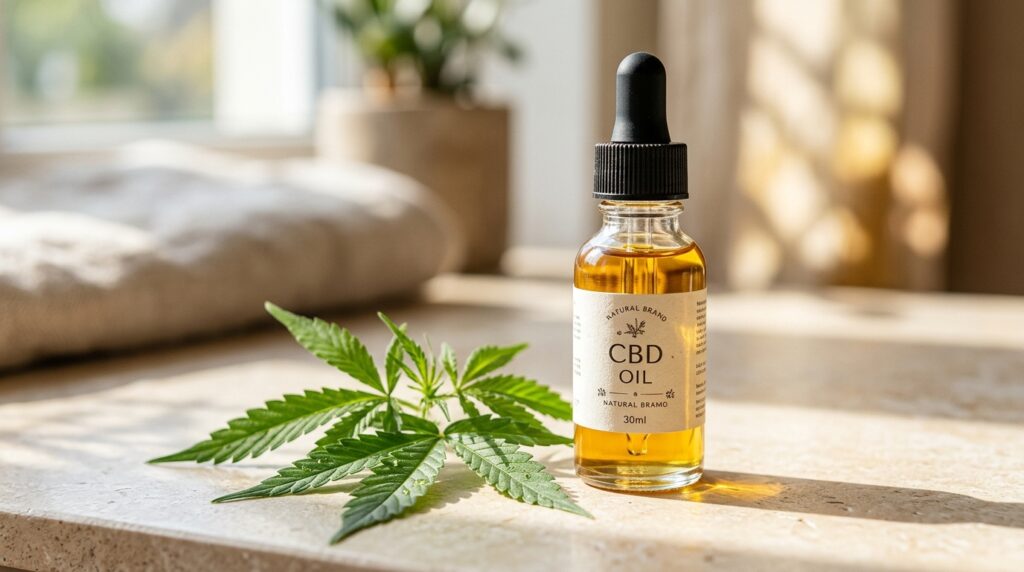
A CBD label is a small document. Read slowly, it answers most questions a buyer would otherwise ask a salesperson.
The trouble is that CBD oil labels use inconsistent wording, and a few phrases mean less than they appear to. A walk through the label, line by line, shows what to trust and what to question.
Decoding the Front of the Bottle
Total milligrams
The largest number on the front is usually the total CBD in the bottle, such as 500 mg, 1,000 mg, or 3,000 mg. It says nothing about strength per serving until it is divided by the bottle size. A bigger number can simply mean a bigger bottle.
Hemp extract, hemp oil, hemp seed oil
Three similar phrases cover three different things. “Hemp extract” and “full spectrum hemp extract” point to cannabinoid-bearing material. “Hemp seed oil” is pressed from seeds and holds negligible CBD. “Hemp oil” is ambiguous and sometimes used for either, so a stated CBD amount is the tiebreaker.
Claims that mean little
Words like “premium,” “pure,” “natural,” and “potent” have no legal definition in this context. “Lab tested” also means little without a report to read. A specific phrase, such as “third-party tested by an ISO 17025 accredited lab, batch 2417,” carries real information.
The Math Behind a Serving
A worked example
A 30 mL bottle labeled 1,500 mg holds 50 mg of CBD per milliliter. A standard dropper often fills to 1 mL, so a full dropper delivers about 50 mg. A half dropper gives about 25 mg. Learning the dropper’s markings prevents accidental double doses.
Price per milligram
A $60 bottle with 1,500 mg costs $0.04 per milligram, and a $25 bottle with 250 mg costs $0.10 per milligram. The cheaper bottle is the costlier product. This number allows fair comparison across strengths and sizes.
Quick reference table
| Bottle strength | Volume | CBD per mL | Half dropper (0.5 mL) |
|---|---|---|---|
| 300 mg | 30 mL | 10 mg | 5 mg |
| 600 mg | 30 mL | 20 mg | 10 mg |
| 1,500 mg | 30 mL | 50 mg | 25 mg |
Back of the Bottle
Ingredient list
The ingredient list shows what carries the CBD: MCT oil, olive oil, hemp seed oil, or something else. It also exposes added flavors, sweeteners, and preservatives. Anyone with allergies reads this section first.
Lot number and expiration
A lot or batch number ties the bottle to a specific production run and to its lab report. The expiration date shows when the maker expects potency to hold. A bottle missing either one makes verification impossible.
THC statement
Products often state “contains less than 0.3 percent THC” or “THC-free.” The first describes the legal limit. The second is a stronger claim and should appear on the lab report as “not detected.” Full spectrum products can show up on drug screens, because the standard urine test targets a THC metabolite, with common screening cutoffs of 50 ng/mL and confirmation cutoffs of 15 ng/mL.
Proof Beyond the Label
The QR code and the report
Many brands print a QR code that opens the lab report. Scanning it should show a batch number matching the bottle, the lab name, and a clear table of results. If the QR code leads to a generic page or to a report for a different batch, that is a mismatch worth questioning.
What the early studies found
In a 2017 JAMA study of 84 online products, about 26 percent contained less CBD than labeled and about 43 percent contained more. THC appeared in roughly one in five samples. The market has improved since, though the study remains the standard reminder to check the report.
Supplement facts and disclaimers
Some labels include a “Supplement Facts” panel, which suggests the maker follows supplement labeling conventions. Most also carry the statement that the product has not been evaluated by the FDA. That statement is standard, and a label without it or with disease claims instead is a concern.
A Fast Pre-Purchase Routine
Five-step check
- Find CBD in milligrams per bottle and per serving
- Confirm “hemp extract” or an equivalent term
- Match the lot number to a lab report
- Read the ingredient list for allergens and additives
- Calculate price per milligram
Handling a short label
If a label omits several of these, the product page or the manufacturer’s customer service line may fill the gaps. A seller who cannot answer a basic question about potency is giving an answer of its own.
When to buy
Once the label, the report, and the math agree, the purchase is straightforward. A small first bottle is enough to start.
Final Thoughts
A CBD label rewards slow reading: total milligrams, serving math, ingredients, lot number, and a matching lab report. Five minutes with a calculator and a QR code covers most of what matters.